In 2026, the feminine hygiene aisle in pharmacies and supermarkets offers a plethora of products that oscillate between two radically different philosophies. On one hand, there are conventional products formulated with foaming agents, synthetic preservatives, and synthetic fragrances, which have dominated the market for decades. On the other hand, there's a new generation of natural products formulated with plant-derived ingredients, certified organic active ingredients, and a simplified ingredient list that addresses women's growing concerns about what they apply to one of the most sensitive and permeable areas of their bodies.
This debate between natural versus chemical products for feminine hygiene is more complex than it seems because it raises legitimate questions that are difficult to answer without precise knowledge of the ingredients involved and their actual impact on the balance of the vaginal flora. Not all conventional products are harmful to intimate flora, and not all natural products are necessarily more effective or safer than their conventional counterparts. The reality is more nuanced and warrants a precise and objective analysis.
What is certain, however, is that the female intimate area is particularly vulnerable to disruptions caused by certain cosmetic ingredients. Its thin and richly vascularized mucous membrane absorbs applied substances more than ordinary skin. Its protective acidic pH can be easily disrupted by formulas with an unsuitable pH. And its protective bacterial flora, dominated by Lactobacilli, is sensitive to antimicrobial agents and endocrine disruptors present in some conventional formulations.
In this article, we present an objective and documented analysis of the advantages and limitations of natural and conventional products for feminine hygiene to help you make informed choices that sustainably preserve your intimate balance.
Which ingredients in conventional products should be avoided for feminine hygiene?
Many conventional feminine hygiene products available in supermarkets and pharmacies contain ingredients whose impact on the balance of vaginal flora is documented and concerning. These ingredients are not all dangerous in the strict toxicological sense of the term, but their regular use on the vulvar mucosa can gradually disrupt the natural pH of the intimate area and weaken the protective bacterial flora, which is your first line of defense against infections and recurrent imbalances.
The vulvar mucosa is one of the most permeable and absorbent areas of the body. Substances applied to this area penetrate faster and deeper into the body than on ordinary skin. This increased permeability justifies particular vigilance regarding the composition of products used daily for intimate cleansing, because chronic exposure to disruptive ingredients, even in small quantities, can have cumulative effects on hormonal and microbiotic balance.
The most problematic ingredients to identify on the labels of your conventional feminine hygiene products are:
Aggressive foaming agents:
- Sodium Lauryl Sulfate or SLS
- Sodium Laureth Sulfate or SLES
- Ammonium Lauryl Sulfate or ALS
Endocrine-disrupting preservatives:
- Parabens in all their forms: methylparaben, propylparaben, butylparaben
- Phenoxyethanol in high concentration
- MIT or Methylisothiazolinone
- CMIT or Chloromethylisothiazolinone
Fragrances and aromatic compounds:
- Fragrance or Parfum: generic mentions that can conceal hundreds of undisclosed chemical compounds
- Limonene
- Linalool
- Eugenol
- Cinnamal
Endocrine disruptors and suspicious compounds:
- Triclosan: controversial antimicrobial agent
- Benzalkonium chloride
- PEG or Polyethylene glycol and its derivatives
- Propylene glycol in high concentration
- Formaldehyde and its releasers like DMDM Hydantoin and Imidazolidinyl Urea
Artificial colorants:
- CI followed by any number: synthetic colorants with no functional interest
- FD&C Red, Blue, Yellow followed by numbers
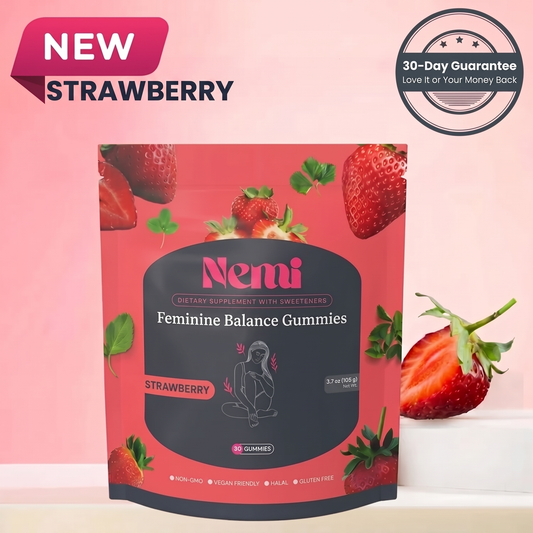
The presence of these ingredients in a feminine hygiene product does not necessarily justify its immediate discontinuation if you tolerate it well. But if you suffer from recurrent intimate imbalances, chronic irritations, or particular sensitivity in the intimate area, identifying and eliminating these ingredients from your hygiene routine is an important first step before considering other interventions. Probiotic food supplements like those offered by Nemi on mynemi.com can effectively complement the switch to products that are more respectful of intimate flora.
The benefits of natural products for feminine intimate hygiene
Natural feminine hygiene products have seen a remarkable boom in recent years, and their growing popularity is based on concrete and documented benefits that justify their adoption by women seeking to take care of their intimate balance in a more respectful and sustainable way.
An adapted pH that respects the natural acidity of the intimate area
The first fundamental advantage of natural feminine hygiene products is their pH-adapted formulation, between 4 and 5, which corresponds to the naturally acidic pH of the vulvar and vaginal area. The best natural products integrate this pH constraint as a non-negotiable formulation criterion, because a product with an unsuitable pH directly disrupts the acidic environment that naturally protects the vaginal mucosa against pathogens. This attention to pH is more systematically present in natural formulas than in conventional products, whose pH is sometimes too alkaline for use on the intimate area.
A simplified ingredient list free of endocrine disruptors
The second advantage is the transparency and simplification of the ingredient list. Certified natural and organic products, such as those labeled Cosmos Organic or Ecocert, are contractually committed to excluding the most controversial ingredients from their formulas. Parabens, aggressive sulfates, synthetic fragrances, artificial colorants, and endocrine disruptors are absent from certified formulas. This exclusion significantly reduces the risk of irritations and hormonal disruptions linked to daily exposure to potentially problematic chemical compounds on the particularly permeable intimate mucosa.
Plant-based active ingredients with documented beneficial properties
The third advantage is the presence of plant-based active ingredients with beneficial properties specifically relevant to feminine intimate health. Aloe vera, with its soothing and moisturizing properties, relieves irritations and maintains the comfort of the vulvar mucosa. Calendula, with its documented anti-inflammatory and healing properties, soothes redness and micro-irritations. Green tea extract, with its antioxidant properties, protects the mucosa from oxidative stress. And naturally derived lactic acid helps maintain the protective acidity of the intimate area. These plant-based active ingredients add real functional value that goes beyond the simple cleansing function of conventional products.
Better tolerance for sensitive skin and women prone to imbalances
The fourth advantage is the better tolerance observed in women with sensitive skin and those who suffer from recurrent intimate imbalances. Women with repeated vaginal yeast infections, recurrent bacterial vaginosis, or chronic irritations frequently report an improvement in their intimate comfort after switching to natural products formulated without the irritating ingredients most frequently involved in these imbalances. This better tolerance is logical from a biological standpoint because the elimination of aggressive foaming agents and synthetic fragrances reduces the level of aggression on the mucous membrane and creates a more favorable environment for maintaining protective flora.
Consistency with a holistic approach to female well-being
The fifth advantage is the consistency with a holistic approach to female well-being that many women are gradually adopting in 2026. Choosing natural feminine hygiene products is part of a broader approach that combines a diet favorable to intimate flora, supplementation with specific probiotics like Nemi gummies available on mynemi.com, and hygiene habits that respect the microbiotic balance. This global consistency across different dimensions of intimate care produces far superior results than a fragmented approach that combines aggressive hygiene products with probiotic supplements whose benefits are partially canceled out by the disruptions caused by these products.
Why are chemical products bad for feminine hygiene?
The question deserves to be asked with nuance, as not all conventional products are uniformly harmful for feminine hygiene. But certain chemical ingredients present in many standard formulas have documented effects on the balance of vaginal flora and should be known to make informed choices.
The first mechanism of harmfulness is the disruption of vaginal pH. Foaming agents like Sodium Lauryl Sulfate have a naturally alkaline pH that directly contradicts the acidic pH between 3.8 and 4.5 essential for the vitality of protective Lactobacilli. Daily use of products with an unsuitable pH gradually degrades the natural acidity of the intimate area and creates an environment that is increasingly less hostile to pathogenic bacteria and opportunistic yeasts like Candida albicans, which is responsible for recurrent vaginal yeast infections.
The second mechanism is the destruction of protective flora. Certain antimicrobial agents like triclosan and benzalkonium chloride present in conventional feminine hygiene products indiscriminately eliminate both pathogenic bacteria and beneficial Lactobacilli. This non-selective action gradually depletes the protective flora and creates a microbiotic void that opportunistic pathogens quickly colonize. This phenomenon explains why some women who use very purifying or antibacterial feminine hygiene products paradoxically develop more vaginal infections than those who use milder products.
The third mechanism is hormonal disruption. Parabens and certain synthetic aromatic compounds present in feminine hygiene fragrances are endocrine disruptors whose absorption by the particularly permeable vulvar mucosa can interfere with the female hormonal system. This hormonal disruption can affect the balance of the vaginal flora, as estrogens play a direct role in the vitality of protective Lactobacilli.
The fourth mechanism is chronic irritation of the mucous membrane. Daily use of products containing synthetic fragrances, artificial colorants, and aggressive foaming agents generates chronic low-grade irritation of the vulvar mucosa, which gradually alters its integrity and its ability to form an effective barrier against pathogens. This chronic irritation is often imperceptible on a daily basis, but its cumulative effects on intimate health manifest in the long term through increased sensitivity and more frequent imbalances.
How to choose the right natural product for feminine hygiene?
The market for natural feminine hygiene products has grown considerably in recent years, with an increasingly wide range that mixes formulas genuinely respectful of intimate flora and products that use natural marketing without real formulation rigor. Here are the most decisive criteria for identifying the best natural products for your feminine hygiene.
The first criterion is official certification. Labels such as Cosmos Organic, Cosmos Natural, or Ecocert are the most reliable certifications to guarantee that a feminine hygiene product meets rigorous standards regarding the nature and origin of its ingredients. These certifications impose minimum percentages of naturally derived ingredients, contractually exclude the most controversial ingredients such as parabens, aggressive sulfates, and synthetic fragrances, and guarantee traceability of the plant ingredients used. A product that presents itself as natural without bearing any official certification deserves careful reading of its ingredient list before purchase.
The second criterion is the pH of the formula. Check that the product's pH is explicitly stated on the packaging and that it is between 4 and 5 to match the naturally acidic pH of the vulvar and vaginal area. This information is increasingly displayed on the packaging of products specifically formulated for quality intimate hygiene. An intimate hygiene product that does not mention its pH or has a pH above 5.5 is not optimal for preserving the natural protective acidity of the intimate area.
The third criterion is careful reading of the INCI list. The INCI list is the standardized list of cosmetic ingredients that must appear on all cosmetic products sold in Europe. Familiarize yourself with the INCI names of the most problematic ingredients detailed in our previous chapter and systematically check for their absence in the ingredient list of any product you are considering using. This reading may seem tedious at first, but it quickly becomes fast and intuitive with a little practice.
The fourth criterion is the consistency of the overall approach. A quality natural intimate hygiene product is part of a care philosophy that goes beyond simple cleansing. It naturally complements a holistic approach to female balance that includes a diet favorable to intimate flora, sufficient hydration, and supplementation with specific probiotics such as Nemi's feminine balance gummies available at mynemi.com, which support the vitality of the vaginal flora from within for lasting and complete results.